
What you can expect
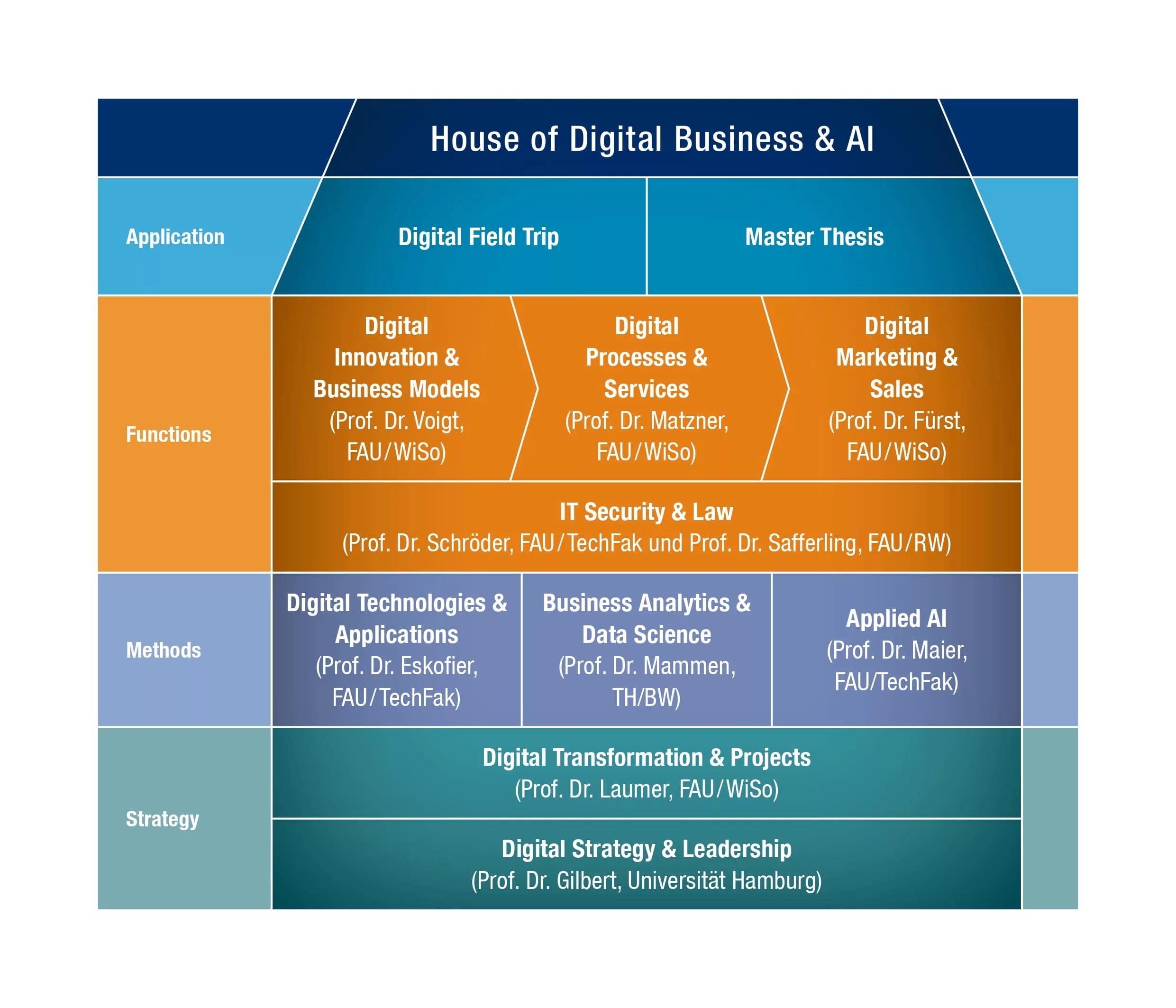
The part-time MBA in Digital Business & AI at FAU Erlangen-Nürnberg includes eleven modules specifically developed for this study program. Together, these modules form the “House of Digital Business & AI”, consisting of the foundation (“Strategy”), two further levels (“Methods” and “Functions”) and the umbrella (“Applications”).

Fundament
(„Strategy“)
Conceptual tools for digital business & AI (including digital business models, digital transformation management, digital forms of work, agile management, change management)

First Level
(„Methods“)
Technical and analytical tools for digital business & AI (including machine learning, deep learning, natural language processing, Internet of Things, cloud computing, blockchain, data science)

Second Level
(„Functions“)
Operational tools for digital business & AI along the value chain (e.g. design thinking, Industry 4.0, robotics, digital processes, e-procurement & e-commerce, online/social media, marketing, digital pricing, digital marketplaces, IT encryption, data protection)

Roof
(„Applications“)
Transfer-related tools to round off and crown the program (especially application in projects and Master’s thesis)
Strategy Module
Digital Strategy & Leadership: This module provides detailed knowledge with regard to the development of digital & AI strategies and the management of companies. Important basic concepts of digitalization and strategic management are first explained. A process model is then presented and its phases discussed. Participants learn to understand the company as a system of interaction between the environment, organizational structure, organizational culture, and corporate strategy against the backdrop of advancing digitalization. They also learn to apply the content discussed to specific practical problems and to independently analyze strategic decisions.
Digital Transformation & Projects: Digitalization and AI projects continue to fail because the resulting changes are not actively shaped and people do not accept them. The aim of this module is to enable participants to analyze, visualize, and discuss the consequences of these projects and possible implementation problems that result, for example, from resistance on the part of the workforce. On completion of this module, participants will be able to understand challenges on the specialist and user side and successfully design digital transformation and AI projects.
Methods Module
Digital Technologies & Applications: Only those who have a deep understanding of digital technologies can use them effectively. Participants in this course deal with the paradigms, concepts, principles, models, methods, and approaches for the effective development of user-friendly technologies. In addition, the role of artificial intelligence, particularly machine learning and deep learning, in the implementation of “smart” technologies will be discussed.
Business Analytics & Data Science: Data forms the basis for decisions in companies. Companies are increasingly utilizing data sets that are too large or too complex for traditional database systems. Such data sets are commonly referred to as mass data (big data). The module covers methods and technologies for storing, processing, integrating and analyzing mass data.
Applied AI: This module not only teaches and deepens knowledge of artificial intelligence, but also demonstrates the application of this knowledge. Participants learn about numerous fields of application of machine learning and deep learning and the opportunities and challenges of the use of artificial intelligence.
Functions Module
IT Security & Law: The module provides an overview of the basics of IT security, cryptography, and IT law. Using various application examples, the security of modern technologies (e.g. blockchain, password-protected encryption, digital currencies) will be discussed and their legal categorisation discussed. The course will also look at how (criminal) law protects IT security and how cybercrime can be prosecuted under criminal law.
Digital Innovation & Business Models: Innovations are the real source of a company’s success. New products and services as well as new processes and business models follow and determine market trends, replace existing solutions, and open up new growth opportunities. In digital competition, creativity and speed are particularly important. Innovations gain comparative advantages. This course provides an overview of digital & AI methods, approaches, processes, and concepts of innovation management. Participants will then analyze innovative business models, in particular data-driven, value-added, and platform business models based on digital technologies such as artificial intelligence. On this basis, they will develop, present, and evaluate our own creative innovation ideas.
Digital Processes & Services: The module focuses on the process mining, which deals with data-supported business process analyses. Process mining is the subject area of the digital industry in which German companies and researchers are global leaders. First, the basics of business process management are examined, taking a closer look at the technical, organizational, and economic aspects of process improvement measures. The module will then cover the analysis methods, tools, and application potential of process mining.
Digital Marketing & Sales: This module deals with concepts, approaches, and tools for marketing and sales in the digital age. It looks at how digital & AI tools can be used to gain data and insights about customers, competitors, and general market developments. It also examines how digitalization and machine learning can help to involve customers in new product development. The definition, differentiation, and enforcement of prices in the digital age will also be addressed. Due to its importance, customer communication using digital tools (e.g. online advertising, social media marketing) and their integration into the overall communication strategy is explained. A special focus is placed on digital sales channels.
Application Module
Digital Field Trip: As part of this extracurricular module, participants travel to a digital hot spot city and get to know exciting digital business & AI start-ups and unicorns. This field trip is rounded off by an entertaining supporting program.
Master Thesis: The Master thesis is written at the end of the program. Depending on the medium-term personal goals of the participants, three different orientations are possible here: “Job Development”: practical project work, “Business Development”: business plan, or “Science/Promotion”: Theoretical work. From finding a topic to the final submission, participants are accompanied and supported by a professor from the MBA program. Supervision is competent, intensive, and personal.